Welcome to A.I. Lab
- +386 1 479 8210
- Večna pot 113, 1000 Ljubljana
- team@ailab.si

Welcome to A.I. Lab
Schizophrenia is a severe mental disorder characterized by disturbances in thinking, perception, emotion, and behavior. It affects multiple areas of functioning, including verbal fluency, verbal memory, working memory, processing speed, attention, and executive functions. Cognitive impairments in schizophrenia are therefore closely linked to quality of everyday life and are often most reflected in social and occupational status.
Diagnosis according to the current international classification of diseases is primarily based on clinical interviews and the professional judgment of a psychiatrist. Clinical psychological test batteries are time-consuming and to some extent subjective, which is why in recent years there has been growing interest in computational tools that could complement clinical assessment with objective measurements.
Researchers from UL FRI, Rok Rajher, Mila Marinković and Assist. Prof. Dr. Jure Žabkar, together with Dr. Polona Rus Prelog from the Faculty of Medicine UL, present in their article Automated Speech-Fluency Explanations for Schizophrenia Diagnosis , published in the journal Scientific Reports , a fully automated and explainable approach to supporting schizophrenia diagnosis based on speech analysis. The study is based on recordings of verbal fluency tests, in which participants list words within a limited time according to predefined rules.
The researchers developed a method based on automatic speech-to-text transcription and on analyzing the meaning of spoken words and speech errors using acoustic and linguistic features. The trained model ultimately estimates the probability of the presence of the disorder. Special attention was given to model explainability – it does not only provide a prediction, but also explains which speech patterns and features contributed most to that prediction.
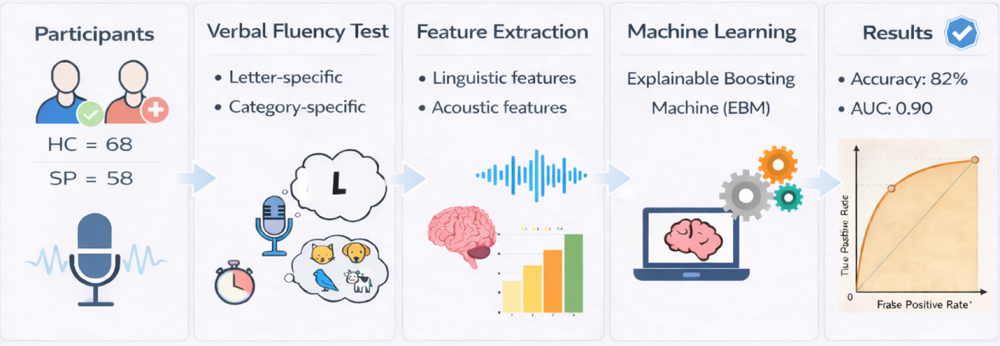
S1: Automated workflow of speech analysis to support schizophrenia diagnosis.
The results show that the automated approach achieves comparable accuracy to existing methods, while significantly simplifying testing and reducing execution time. The practical value of the research is particularly evident in the possibility of using such a system as a support tool for early screening, monitoring disease progression, or evaluating treatment effects. Since the methodology used is essentially language-independent, it also provides a solid foundation for further research in other linguistic environments.
You can read the full article here: